




This guide is for first-time visitors who want to see Whitby Abbey without overcomplicating it. If you are deciding whether it is worth the walk, how to fit it into a day in Whitby, or what to expect once you get there, this is the practical version.
Quick answer
Whitby Abbey is one of the town’s main landmarks and is worth visiting if you want big views, local history, and a site that feels central to Whitby rather than just an extra stop. It sits on the East Cliff above town, is about half a mile from the centre, and can be reached on foot via the 199 steps or by taking the easier route up. Inside the site, you are not just looking at the abbey ruins: there is also a visitor centre and museum in the old Cholmley mansion. For most first-time visitors, allowing around 1.5 to 2 hours works well.
Why visit Whitby Abbey at all?
If you are only in Whitby once, the abbey is one of the places that makes the town feel like Whitby. It is not just a ruined building on a hill. It is tied into the town’s skyline, local history, the East Cliff setting, and the broader Whitby atmosphere people come for in the first place. English Heritage describes the site as the remains of the medieval abbey church, with the visible ruins mainly dating from the 13th century onwards, and its headland position is a big part of why it stands out so much.
This is a strong pick if you like:
- historic sites with proper visual impact
- coastal views
- combining one main attraction with a walk around town
It is a weaker pick if:
- nobody in your group likes history at all
- you want a quick five-minute stop with no walking
- steep routes are likely to be a problem
What makes Whitby Abbey important?
Whitby Abbey matters for more than the view. The first monastery on the site was founded in about 657, and the site became one of the most important religious centres in the Anglo-Saxon world. It was also the setting for the Synod of Whitby in 664, a major event in the history of Christianity in England. The later headland ruins most visitors recognise today are from the Benedictine abbey founded after the Norman Conquest.
That means the site works on two levels:
- it is visually one of Whitby’s signature sights
- it actually has the depth to justify visiting, not just photographing from below
If you are not a deep history person, that is fine. You do not need specialist knowledge to get value from it. But it helps to know this is more than just “old ruins.”
How to get there without making life harder
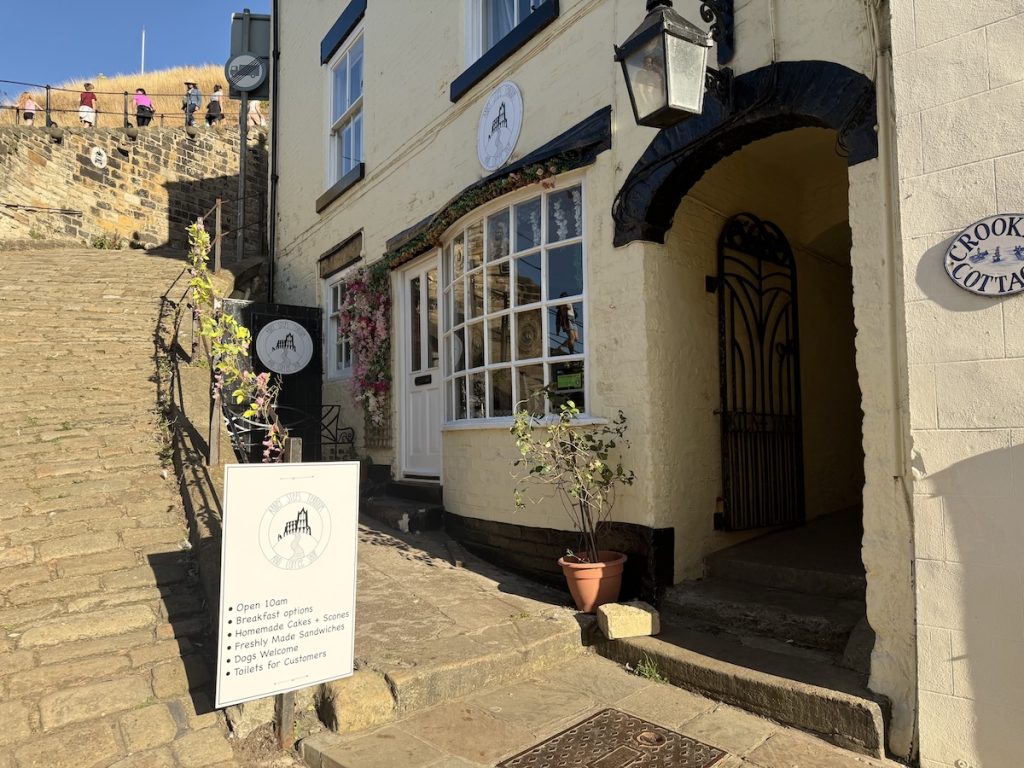
Whitby Abbey is about a 15-minute walk from the town centre and is famously reached by the 199 steps, which do have resting points on the way up. That is the classic approach and the one many first-time visitors want to do at least once.
That said, not everyone needs to force the steps.
For first-time visitors, the main choice is simple:
Use the 199 steps if:
- you want the classic Whitby approach
- you do not mind a climb
- you want the sense of arriving at the abbey from town
Take an easier route up if:
- you are with older relatives
- you have a buggy
- you want to save energy for the site itself
- the weather is poor
The mistake is assuming the steps are mandatory. They are iconic, but they are not the only sensible option.
What you actually see once you are there
A lot of first-time visitors think the abbey is only the ruin itself. The site offers more than that. English Heritage says the visitor centre and museum are housed in the 17th-century Cholmley mansion and include displays covering the abbey’s long story, with objects linked to its Anglo-Saxon, medieval, and later history.
In practical terms, the visit usually has three parts:
- the approach and views
- the abbey ruins themselves
- the visitor centre and museum
That mix is why the site works better than some historic attractions that are impressive for ten minutes and then done. Here, you can move between outdoor viewing and indoor interpretation, which also helps on colder or mixed-weather days.
How long should you allow?
For most first-time visitors, around 1.5 to 2 hours is about right.
That gives you enough time to:
- get up there without rushing
- walk the ruins properly
- look around the museum and visitor centre
- spend a bit of time on the views
You can do it faster if you are moving quickly and mainly want the landmark and photos. You may want longer if you like reading displays or are combining it with a slower East Cliff walk.
My blunt take: do not squeeze it into a tiny slot. Whitby Abbey is better when it feels like one of the main parts of the day, not something you are trying to cram in before lunch.
Is it good for families, older visitors, or bad weather?
Families
It can work well for families because the site is visually open and the approach feels like part of the experience. English Heritage’s family guide says there is a paved pathway from the car park to the visitor entrance, most of the grounds are flat and buggy friendly, and some ground can be uneven, so sturdy footwear is a good idea.
Older visitors or limited mobility
The abbey is still possible, but route choice matters. The easier approach is usually the smarter move over forcing the 199 steps.
Bad weather
You can still visit, but it becomes more about timing. In strong wind or heavy rain, the exposed setting will feel much harsher than the town centre. The visitor centre helps, but the abbey is best enjoyed when conditions are at least reasonable.
Best option for most first-time visitors
For most people, I would do it like this:
Go up once, make the abbey one of the main anchors of the day, spend proper time on both the ruins and the museum, then come back down into town for food or a harbour walk.
That gives you the best balance:
- one major historic site
- one strong viewpoint over Whitby
- a visit that actually feels distinct from the rest of town
If you are choosing between just viewing it from below or going in properly, I would usually say go in. The view from town is good, but the full visit is what makes the abbey more than just background scenery.